
Do you need a degree to be an Accountant? The short answer is no — but the routes, qualifications and trade-offs matter enormously. This complete guide covers every path into accounting, with or without a university degree.
No, you do not need a degree to become an accountant. In the UK, US and most other countries, you can qualify as a professional accountant through vocational qualifications, professional certifications and apprenticeships that do not require a university degree. Routes such as the AAT (Association of Accounting Technicians), ACCA and CIMA are all accessible to non-graduates. Many highly successful chartered accountants never attended university.
✅ Verdict: A degree is not a legal or professional requirement to become an accountant. It is one route in — but not the only one, and in many cases not the fastest or most cost-effective one.
This is one of the most searched career questions in accounting — and the answer surprises many people. The accounting profession has long recognised that talent, professional qualification and practical experience matter far more than the possession of a university degree. What is required is the right qualification — and there are several routes to obtaining one.
That said, the path you take will affect the time it takes, the employers who consider you, the roles available at entry level, and to some extent your starting salary. Understanding those differences is what this guide is for.
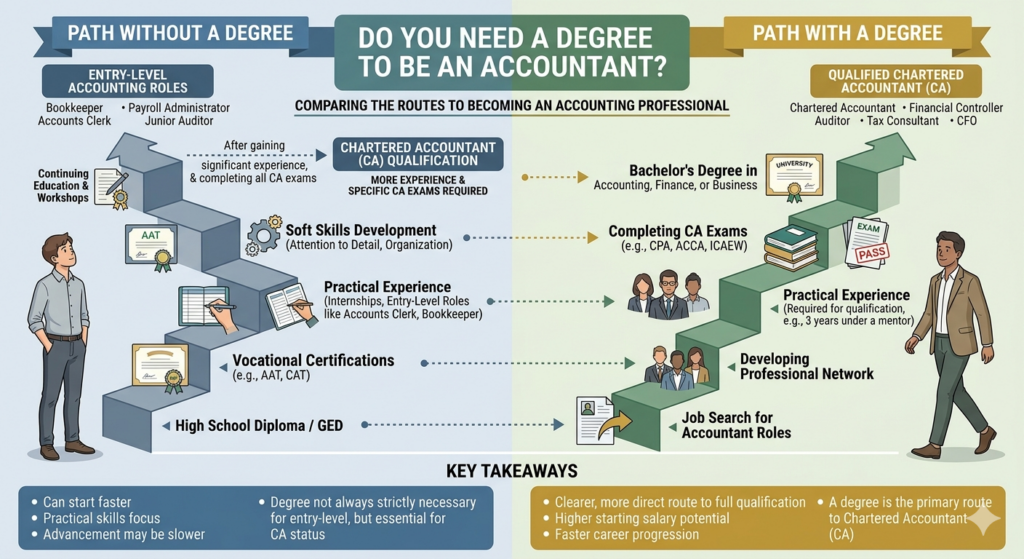
Routes Into Accounting: With and Without a Degree
There are four main routes into the accounting profession. Each has its own timeline, cost profile, entry requirements and career ceiling. Understanding all four allows you to make the right choice for your circumstances.
Route 01: University Degree → Professional Qualification
Study a relevant degree (accounting, finance, economics), then complete professional exams (ACCA, CIMA, ACA). Graduate training schemes at large firms typically fund your exams. Timeline: 6–7 years total.
Route 02: AAT → ACCA or CIMA (No Degree Required)
Start with the AAT qualification at 16+, work as an accounts technician, then progress to ACCA or CIMA. Earn while you learn. Timeline: 5–8 years to chartered status. No degree required at any stage.
Route 03: Apprenticeship
Degree-level apprenticeships in accounting are increasingly common. You earn a salary, get on-the-job experience and gain professional qualifications — all funded by your employer. No degree or tuition fees required.
Route 04: Work Up From Bookkeeping
Enter as a bookkeeper or accounts assistant, gain ICB or AAT qualifications on the job, and progress through the organisation. Slower but practical — and available to anyone regardless of educational background.
“The accounting profession is one of the few remaining careers where genuine merit — measured in qualifications and competence — still consistently outweighs the prestige of your university.”
Accounting Qualifications You Can Get Without a Degree
Quick Answer — No-Degree Qualifications
The main accounting qualifications accessible without a university degree are:
- AAT — Association of Accounting Technicians (UK). Entry at 16+, no prior qualifications needed at foundation level.
- ICB — Institute of Certified Bookkeepers. Entry-level bookkeeping qualification.
- ATT — Association of Taxation Technicians. Tax-focused qualification, no degree required.
- ACCA — Open to non-graduates via the AAT route or with relevant work experience.
- CIMA — Chartered Institute of Management Accountants. Non-graduate entry available.
AAT — The Most Common Starting Point
The AAT (Association of Accounting Technicians) qualification is the most widely used entry route into UK accounting for non-graduates. It is structured across three levels — Foundation, Advanced and Professional — and can be started at age 16 with no prior qualifications for the foundation level. Many employers actively hire AAT students and fund their studies, making it possible to earn while you qualify.
Crucially, the AAT is not a dead end. It provides direct exemptions from several ACCA and CIMA exams, meaning that a qualified AAT accountant can progress to full chartered status without repeating work already covered. This AAT-to-ACCA pathway is now one of the most common routes to chartered status in the UK.
ACCA — Accessible Without a Degree
The ACCA (Association of Chartered Certified Accountants) is a globally recognised chartered qualification. While graduates can enter at the Applied Knowledge or Applied Skills level, non-graduates with relevant AAT qualifications or work experience can also access the qualification. The ACCA has entry requirements that assess competence, not the possession of a university degree — making it genuinely accessible to career changers and school leavers alike.
CIMA — Management Accounting Route
The CIMA (Chartered Institute of Management Accountants) qualification focuses on management and strategic accounting within businesses. Like ACCA, it has a non-graduate entry route and is structured in levels that allow candidates to progress at their own pace. CIMA is particularly well regarded in industry and corporate finance roles.
CPA — Important Exception for US-Based Readers
In the United States, the CPA (Certified Public Accountant) exam requires candidates to have completed 150 credit hours of education — which in practice usually means a bachelor’s degree plus additional coursework. Most US states require a degree as a prerequisite. Non-degree holders in the US therefore typically pursue bookkeeping roles, enrol in community college accounting programmes, or consider non-CPA accounting certifications such as the CMA (Certified Management Accountant).
| Qualification | Country | Degree Required? | Level | Duration |
|---|---|---|---|---|
| AAT | UK | No | Technician | 1–3 years |
| ICB | UK | No | Bookkeeper | 6–18 months |
| ATT | UK | No | Tax Technician | 1–2 years |
| ACCA | Global | Via AAT route | Chartered | 3–5 years |
| CIMA | Global | Via experience | Chartered | 3–5 years |
| ACA (ICAEW) | UK | Usually yes | Chartered | 3 years (training contract) |
| CPA | USA | Usually yes | Certified Public Accountant | 4–5 years |
| CMA | USA/Global | No | Management Accountant | 1–2 years |
Degree vs No Degree: The Real-World Trade-Offs
While a degree is not required to become an accountant, the two routes have different practical implications — particularly in the early career stages. Here is an objective comparison of both paths.
✓ Benefits of a Degree Route
- Easier access to graduate training schemes at Big Four firms
- Broader academic foundation in economics, law and business
- Higher starting salaries at large employers
- More straightforward entry to US CPA exam
- Recognised internationally in more contexts
- University network and campus recruitment access
✗ Drawbacks of a Degree Route
- Significant cost — tuition fees plus 3–4 years without full earnings
- Slower to enter the workforce and build experience
- Degree does not replace professional qualification — you still need ACCA/CIMA
- Accounting degree not required — any degree accepted by most employers
- Total qualification timeline is often longer overall
✓ Benefits of the Non-Degree Route
- Earn a salary while studying — no tuition fee debt
- Earlier entry into the profession and faster experience accumulation
- AAT is widely respected and opens real employment doors
- Clear progression path: AAT → ACCA/CIMA → Chartered
- Apprenticeships available with employer-funded training
- Long-term salary parity with degree-holders at chartered level
✗ Drawbacks of the Non-Degree Route
- Some large employers require a degree for graduate intake
- Lower entry-level salaries in early career stages
- Less access to structured graduate training programmes
- May face bias from some traditional employers
- US CPA pathway is significantly more difficult without a degree
Key insight: At the chartered level — ACCA, CIMA, ACA — employers rarely distinguish between those who arrived via a degree and those who arrived via the AAT route. The qualification itself is what matters. The degree advantage is largely confined to the entry-level and early career stages.
How to Become an Accountant Without a Degree: Step by Step
If you want to pursue an accounting career without going to university, the following pathway is the most well-established and widely respected route in the UK. US readers should substitute the AAT with an Associate’s degree in accounting or the CMA qualification.
- 1 Start with AAT Foundation (Level 2)Begin at AAT Level 2 Foundation Certificate in Accounting. No prior qualifications are required. Courses are available through colleges, online providers and as employer-funded apprenticeships. Duration: 6–12 months.
- 2 Progress to AAT Advanced (Level 3) and Professional (Level 4)Complete Levels 3 and 4 to become a qualified Accounting Technician. Many students study while working in accounts assistant or bookkeeping roles. Total AAT journey: 1–3 years.
- 3 Gain practical work experienceWork in accounts payable, accounts receivable, payroll or management accounts. Practical experience is required for both ACCA and CIMA alongside the exams — building it early strengthens your application and your competence.
- 4 Register for ACCA or CIMA examsA full AAT qualification earns you exemptions from the early ACCA or CIMA papers, saving both time and money. Register, choose your specialism, and begin working through the professional-level exams.
- 5 Complete your professional qualification and achieve chartered statusPass all remaining exams and satisfy the work experience requirements (3 years relevant experience for ACCA). You are now a Chartered Certified Accountant — fully equivalent in the market to any degree-holding colleague.
Accountant Salary: Does a Degree Make a Difference?
Salary in accounting is primarily determined by qualification level, years of experience, employer size, sector and location.
Do you need a degree to be an Accountant? While a degree provides a modest salary advantage at entry level — but this advantage narrows significantly as careers progress, and at the chartered level it is largely irrelevant.
| Career Stage | With Degree (UK) | Without Degree (UK) | Gap |
|---|---|---|---|
| Entry Level / Trainee | £24,000 – £30,000 | £18,000 – £24,000 | Moderate |
| Part-Qualified (AAT / Part ACCA) | £28,000 – £38,000 | £25,000 – £35,000 | Small |
| Newly Qualified (ACCA / CIMA) | £40,000 – £55,000 | £40,000 – £55,000 | Negligible |
| Senior / Manager | £55,000 – £80,000+ | £55,000 – £80,000+ | None |
| Finance Director / CFO | £100,000+ | £100,000+ | None |
It is also worth noting the net financial position. A non-graduate who begins earning at 18 rather than 21 — and avoids tuition fee debt — may be in a significantly stronger financial position by their mid-twenties than a degree-holder, even accounting for any entry-level salary differential.
What Do Employers Look for in Accounting Candidates?
Large Firms (Big Four and Top 10)
The Big Four accountancy firms — Deloitte, PwC, EY and KPMG — have traditionally recruited heavily from universities via graduate schemes. These schemes typically require a 2:1 degree, though the subject can be anything. However, all four firms now also offer school-leaver programmes and degree apprenticeships that are specifically designed for non-graduates — reflecting a broader industry shift toward recognising talent through multiple routes.
SMEs and Industry Roles
Small and medium-sized employers — which account for the vast majority of accounting jobs — are far less concerned with degree status. What they want to see is the right qualification (AAT, ACCA, CIMA), relevant experience, and strong numeracy and communication skills. In practice, many of the most valued accountants in business entered the profession without a degree.
Sectors That Value Professional Qualification Over Degree
Management accounting, public sector finance, charity finance, bookkeeping and tax advisory roles all place professional qualification and experience above educational background. In these sectors, the AAT-to-ACCA or CIMA pathway carries exactly the same weight as a degree-plus-qualification route.
Frequently Asked Questions – Do you need a degree to be an accountant?
Do you need a degree to be an accountant?
No. You do not need a degree to become an accountant. Professional qualifications such as AAT, ACCA and CIMA are all accessible without a university degree. Many successful chartered accountants qualified via the AAT route without ever attending university.
What accounting qualifications can I get without a degree?
Without a degree, you can obtain: AAT (Association of Accounting Technicians), ICB (Institute of Certified Bookkeepers), ATT (Association of Taxation Technicians), and in most cases ACCA and CIMA — both of which have entry routes for non-graduates via the AAT pathway or relevant work experience.
How long does it take to become an accountant without a degree?
You can become a qualified AAT accounting technician in 1–3 years. Progressing to full chartered status (ACCA or CIMA) typically takes a further 3–5 years, making the total journey around 4–8 years from school-leaver to chartered accountant — comparable to or faster than the degree route when you account for the 3–4 years of university.
Can I become a CPA without a degree?
In most US states, a bachelor’s degree and 150 credit hours are required to sit the CPA exam, making a degree effectively necessary in the US. However, equivalent international qualifications like ACCA and CIMA — which are also recognised in the US — can be achieved without a degree.
Do accountants earn more with a degree?
Degree-holders may earn slightly more at entry level, particularly at large firms. However, at the newly qualified chartered stage (ACCA, CIMA), salary levels are essentially identical regardless of whether the candidate holds a degree. Long-term earning potential in accounting is determined by qualification, experience and sector — not undergraduate degree.
Is AAT a good alternative to a degree in accounting?
Yes. The AAT is a well-respected, industry-recognised qualification that provides a strong foundation for an accounting career. It is widely accepted by employers, leads directly to ACCA and CIMA via exemptions, and allows you to earn a salary while studying. For many people, it is a better route than a degree.
The Verdict
No degree needed. AAT → ACCA or CIMA is a fully respected, well-paid path to chartered accountant status. The degree advantage disappears by the mid-career stage.
Key Qualifications
- AAT — Entry at 16, no degree
- ACCA — Global, via AAT route
- CIMA — Management focus
- ICB — Bookkeeping entry
- ATT — Tax specialism
- CMA — US non-degree option
Accounting Career Guide · Do You Need a Degree to Be an Accountant? · For reference only. Always verify qualification requirements with the relevant professional body before enrolling.